
The Finnish Language
aka Suomalainen kieli (with a bonus audio track at the end!)

I just wanted to share a bit of my indignation at the Finnish language. Or maybe indignation isn’t the right word. I find myself saying, “Oh, come on. You’ve got to be kidding me!” fairly regularly. Perhaps more disbelief than indignation? Either way, Finnish can feel a bit much when you’re trying to learn it.
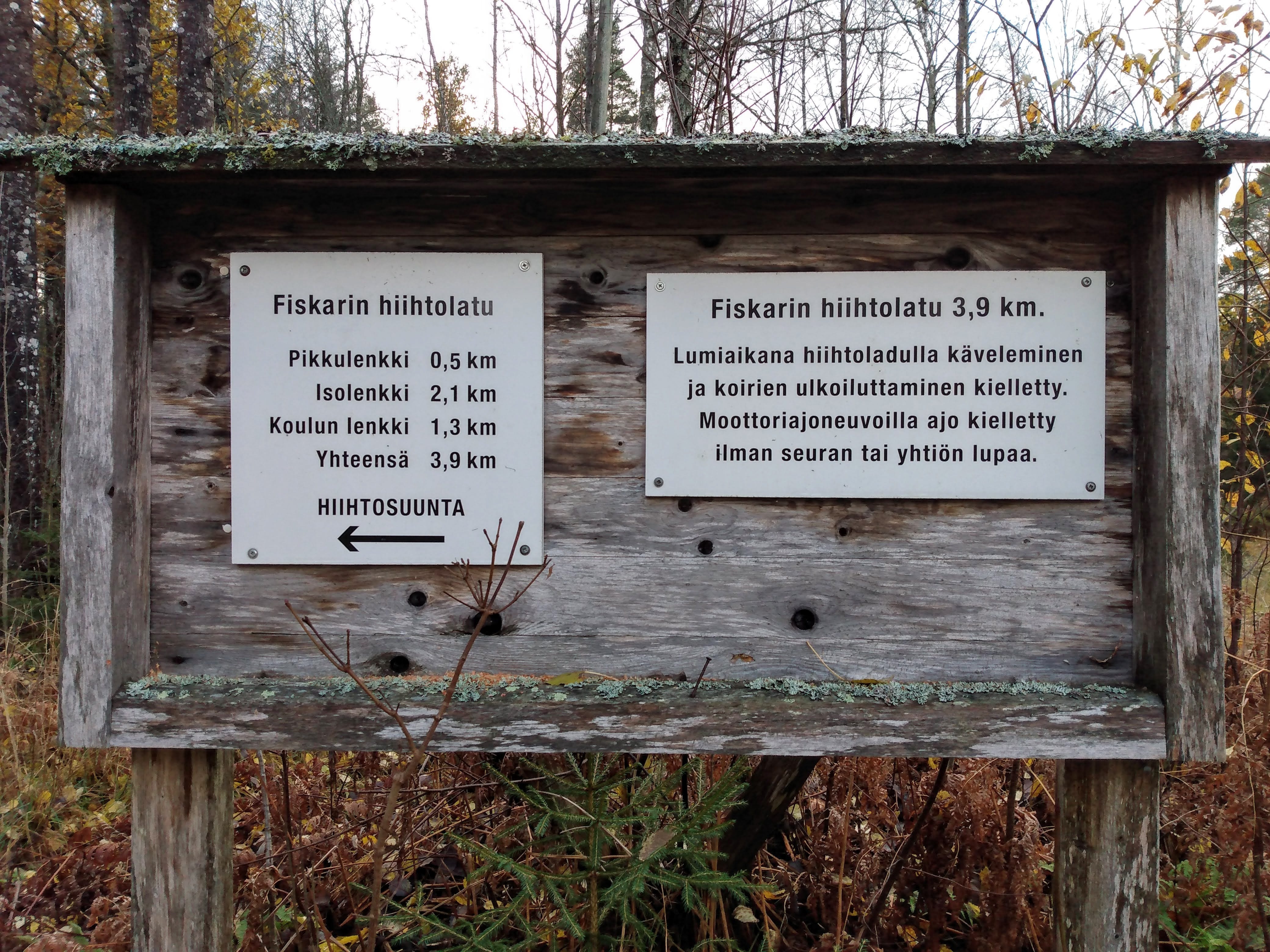
This is the trailhead for a ski trail/nature walk that has street lights along the entire trail.
While I’m sure there are much better examples all over the web, I wanted to share some everyday examples of how Finnish goes down.
Take the word “water.” In the nominative form (the one you’ll find in the dictionary), “water” is “vesi.”
But “I drink water” is “Minä juon vettä.” (Minä = I, juon = I drink.)
vettä = water.
If I swam in the water, “Minä uin vedessä.” (uin = I swam.)
vedessä = in the water.
When I get out of the water, “Pääsin vedestä”
vedestä = from the water.
And so on. There are 12 other cases (16 total), so I’ll stop there. The up-shot is that you have to be able to recognize vesi, vettä, vedessä, et al, as referring to water.
Of course I wanted to impress you, so I picked a changling noun (there are many to choose from). Here are the cases for a more straight-forward example:
dog = koira, koiran, koiraa, koiran (again, but a different case), koirassa, koirasta, koiraan, koiralla, koiralta, koiralle, koirana, koiraksi, koiratta, koirineen, koirin. Sorry I can’t include the plural versions, but I don’t know them yet, other than koirat, which is the nominative plural.
Verbs can be similarly slippery. “To see” is “nähdä.” But “I see” is “näen,” and “she sees” is “näkee” Where did that “k” come from? Where did the “h” and the “d” go? Who would think nähdä, näen, and näkee are all the same damn word?
As you have probably noticed, Finnish words have no common roots with English words. Additionally, vowels are used quite differently that English speakers are accustomed to. How long you say the vowel for matters. Tapaan sinut = I will meet you. Tapan sinut = I will kill you. Ya better pronounce that second “a” if you’re telling someone you’ll meet then at later!
There are also gobs of compound words like “lastenvaatekaupassa,” which is really three words squashed together. “Lasten” is “children’s” (but “child” is “lapsi”), “vaate” is “clothing,” and “kaupassa” is “in the store.” It can be tricky to recognize the individual words when they are strung together and in their various cases.
To top it off, written and spoken Finnish are different. You write “Minä olen Mirja” (I am Mirja), but say “Mä oon Mirja.” “Sinä olet” (you are) becomes “sä oot” when speaking. Sigh.
Of course lots of people do manage to learn Finnish, but there are days when it feels pretty much impossible that I personally will get there.
On the up side, I’m making my peace with talking Finnish despite multiple mistakes per sentance (literally). My initial feelings of cringy embarrassment have faded. The only way I have any chance of actually learning is by practicing, and if I say things like “My Finnish is room,” along the way, so be it. (If I had said “huono” rather than “huone” I would have said, “My Finnish is bad,” as intended. I was clarifying to my cousins that their English is not bad. As in, if your English is bad, what’s my Finnish?)
And I was very happy my mom had good things to say about my accent the other day. I’m making progress! F is too, 12-year-old style, and learning important sentances like “I will drown you in ketsup,” along with all the key swear words. Meanwhile W responds “En puhu suomea” (I don’t speak Finnish) to any and all attempts to teach him Finnish words or phrases.
If you want to hear me saying the Finnish words from this post, I’ve recorded a brief audio track for you.
So wonderful to hear your voice. Of course it sounds perfect, and also intriguing, to me... but I can see the cause for indignation!
I think many native speakers say you gotta be kidding me about our language too, from time to time.
I actually used to know what happened to the letters in the different forms of the same word. It's something to do with linguistic history, but it's been more than a decade since those classes in university, and all that knowledge has since evaporated.